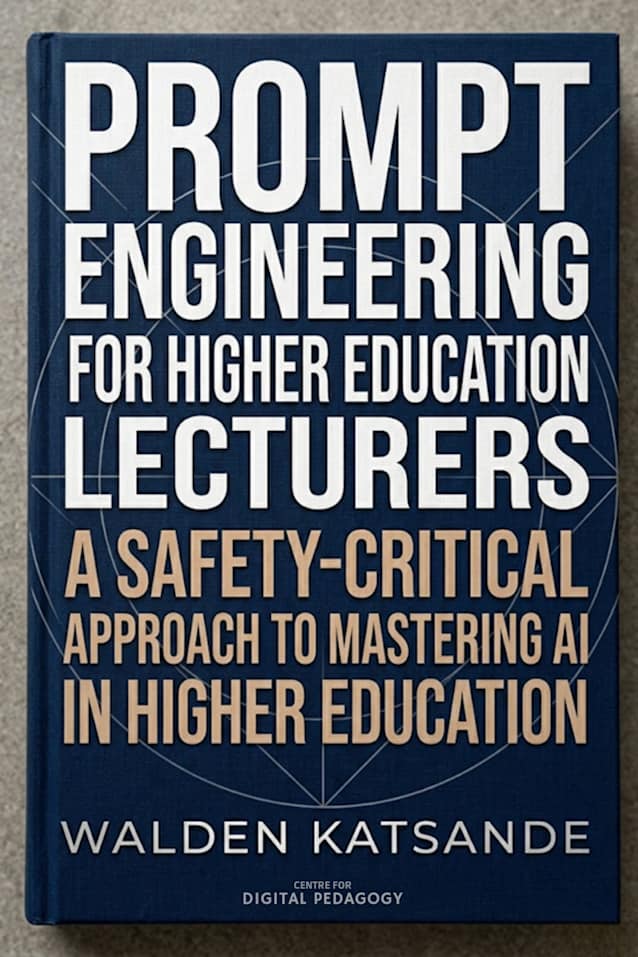
Prompt Engineering for Higher Education Lecturers: A Safety-Critical Approach to Mastering AI in Higher Education
About
Unlock the Power of AI with the Precision of an Air Traffic Controller.
In the world of air traffic control, a misunderstood word isn’t just an error, it’s an operational risk. Walden Katsande, a seasoned aviator with over 30 years of experience in high-stakes instruction, brings that same “safety-critical” rigor to the world of academia in Prompt Engineering for Higher Education Lecturers.
As generative AI transforms the classroom, many educators find themselves receiving generic, unusable, or “hallucinated” outputs. The reason? We are prompting AI with the same vague language we use with humans. AI does not have judgment; it only follows instructions.
This book provides a revolutionary framework, the Six-Component Prompt Architecture designed to bridge the gap between casual AI use and intentional AI integration. Drawing on analogies from the control tower and the radar screen, Katsande teaches lecturers how to:
- Master the CRISPY Framework: Define Role, Context, Objective, Constraints, Deliverables, and Format to eliminate ambiguity.
- Apply Discipline-Specific Patterns: Use pre-built templates for humanities, STEM, health sciences, and teacher training.
- Maintain the “Human Anchor”: Develop verification habits to catch AI errors and hallucinations before they reach students.
- Design AI-Integrated Assignments: Create rubrics and transparency statements that prioritize student thinking over AI generation.
Whether you are designing a complex engineering lab, facilitating a postcolonial literature seminar, or building a custom GPT for your department, The Prompt Engineering for Higher Education Lecturers is your safety manual for the AI era